

I. The Context for Change
Corporate venture capital has entered a phase of scale and permanence: A record 3000+ active corporate venture investors now operate globally*, underscoring CVCs growing impact on the venture investing ecosystem. What began as a tool for strategic experimentation and innovation has evolved to deliver measurable value, disciplined governance, and a clear connection to the parent company’s priorities. As this shift takes hold, many corporations are reassessing whether their venture programs still align with evolving leadership agendas, tightened capital budgets, or changing innovation strategies.
The result is a quiet but significant signal: a number of CVC units at corporations are being restructured, scaled down, or wound down entirely leaving parent companies with complex portfolios to manage and critical decisions to make about the future of their venture assets.
*Source: Global Corporate Venturing “The World of Corporate Venturing 2026” Report.

Exiting a CVC program is not merely a financial exercise. It’s a strategic process that touches founders, co-investors, internal stakeholders, and the corporation’s credibility in the innovation ecosystem. Navigating this transition in a way that preserves value, honors relationships, and maintains optionality for the future can be a challenge that many CVC professionals may find daunting.
This paper examines the primary pathways available to corporations seeking to harvest or exit their CVC portfolios. It aims to provide a clear framework for decision making and a practical understanding of the mechanisms, trade-offs, and industry lessons that can guide a responsible and economically sound transition.
II. The Lifecycle of a Corporate Venture Arm
A corporate venture arm follows a more intricate and less linear path than its traditional venture capital counterparts. Although most CVC programs begin with a burst of enthusiasm and a clear mandate to explore emerging technologies, their long-term trajectory is shaped by corporate priorities that shift over time. The typical lifecycle unfolds through four broad stages:
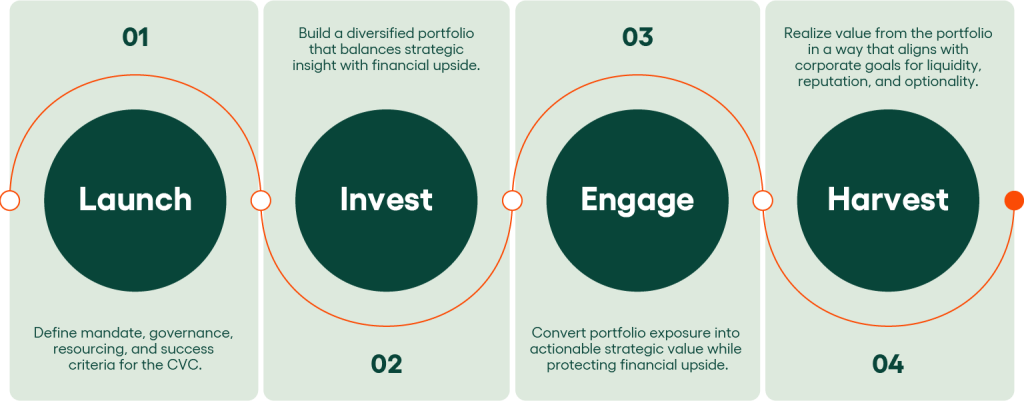
Unlike independent venture funds, CVCs operate within the constraints and incentives of a larger enterprise. They measure success not only in financial returns but also in strategic relevance, market insight, business unit engagement, and influence on corporate innovation. This dual mandate creates both opportunity and complexity. It also exposes CVCs to challenges that become more pronounced as they mature. Strategic drift can arise when the corporate strategy evolves faster than the portfolio. ROI can be difficult to quantify, especially if the value is indirect or diffused across business units. Leadership fatigue can set in when senior executives lose patience with long time horizons or ambiguous outcomes.

These dynamics highlight the importance of viewing the CVC lifecycle holistically. Launching a CVC requires significant attention, resources, and strategic alignment, yet the back end of the lifecycle is often overlooked until it becomes urgent. Thoughtful planning for the harvesting chapter of a CVC, including clear expectations about governance and exit pathways, is essential to ensuring that the program creates lasting value rather than lingering as an under-managed legacy asset.
III. Portfolio Harvesting for Corporate Venture Investors
Portfolio harvesting is a critical but often underappreciated phase in the corporate venture capital lifecycle. While the launch and investment stages naturally attract attention and resources, the manner in which a portfolio is managed to exit can determine whether a CVC program is remembered as a strategic success or a costly experiment. In essence, portfolio harvesting is the process of converting paper value, strategic insights, and optionality into tangible outcomes for the parent company.
In a corporate context, harvesting encompasses both financial and strategic dimensions. Financial harvesting is the most straightforward. It involves realizing gains through liquidity events such as mergers and acquisitions, initial public offerings, or secondary sales. For corporations, the goal is to capture the monetary value of their investments while minimizing disruption to business units and preserving the reputation of the corporate brand within the startup ecosystem. Timing, structure, and governance are key considerations, particularly when portfolio companies are still maturing or when the corporate’s balance sheet and reporting requirements impose constraints.
Equally important is strategic harvesting, which focuses on extracting operational or intellectual value from portfolio companies without necessarily liquidating positions. This can take many forms: licensing new technology to integrate into the parent’s products or services, creating commercial partnerships, recruiting talent, or acquiring early insight into emerging markets and business models. Strategic harvesting ensures that the corporation derives measurable benefit even if a financial exit is not imminent. It also provides flexibility for selective acquisitions or deeper collaborations later, preserving optionality and strategic optionality.

The dual nature of portfolio harvesting, in particular financial and strategic, requires careful planning. Unlike traditional venture capital funds, which primarily optimize for financial return, corporate venture arms must consider both return on investment and return on insight. This complexity often explains why many CVC units struggle with the harvest phase. Strategic misalignment, lack of governance, or delayed planning can result in prolonged portfolios with low liquidity, eroded value, or missed integration opportunities.
Corporations must establish clear policies for triaging investments, determining exit readiness, and aligning portfolio decisions with overarching corporate priorities. Well structured and diligently maintained data rooms, transparent valuation processes, and structured engagement playbooks help mitigate risk, streamline exits, and maintain credibility. By treating the harvest phase as deliberately and strategically as the investment phase, CVCs can transform what might otherwise be a long-tail administrative burden into a source of financial return, strategic advantage, and sustained innovation insight.
IV. Strategic Triggers for CVC Exit Decisions
Corporate venture capital programs do not operate in a vacuum. Their evolution and ultimate fate are closely tied to the strategic priorities, financial constraints, and leadership perspectives of the parent company. Understanding the key triggers that prompt a corporation to reconsider or exit its CVC program is essential for designing disciplined, value-preserving transition strategies.

One of the most common drivers is leadership change. A new CEO, CFO, or board may reassess the alignment of the venture portfolio with the company’s broader strategy. Even a successful CVC program can be deemed non-core if the incoming leadership prioritizes capital efficiency, operational focus, or risk reduction. In these circumstances, the program’s continuation depends less on past performance and more on its perceived strategic relevance.
Financial pressures are another frequent catalyst. Corporations facing constrained capital budgets, increased shareholder scrutiny, or competing investment priorities may decide to reduce or wind down their venture activity. Liquidity from realized exits can be redeployed into core business initiatives, while ongoing capital commitments to venture investments are paused or discontinued. The portfolio’s maturity and the anticipated timing of exits often influence whether the corporation opts for a gradual run-off or a more immediate portfolio sale.
Industry dynamics and shifts in innovation strategy also play a critical role. Emerging technologies, market disruptions, or changes in the competitive landscape can render the original CVC thesis less relevant. For example, a parent company may pivot from broad exploratory investments to focused partnerships or direct acquisitions in specific technology areas. In such cases, selective divestiture or internal transfer of assets to business units allows the corporation to retain value while reallocating resources to more aligned initiatives.
Limited financial or strategic returns can prompt reassessment as well. Measuring the impact of a CVC program is inherently challenging, particularly when strategic benefits are diffuse or indirect. A portfolio that fails to generate meaningful insights, integration opportunities, or tangible returns may be considered underperforming relative to alternative uses of capital. This assessment often drives decisions to restructure, spin out, or fully exit the venture program.
Finally, external pressures such as mergers, acquisitions, or regulatory scrutiny can accelerate the need for exit planning. During corporate restructurings, the CVC may be identified as a non-essential function, prompting either a managed wind-down or an outright sale of assets. Similarly, heightened regulatory focus on corporate disclosures or conflicts of interest may make the ongoing operation of a CVC impractical or undesirable.
In practice, these triggers rarely operate in isolation. A change in leadership may coincide with capital pressures, shifts in strategy, or the maturation of a portfolio, creating a confluence of factors that makes active portfolio harvesting or exit the most prudent course. Recognizing these triggers early allows corporations to plan a structured transition, preserve strategic optionality, maintain relationships with founders and co-investors, and optimize both financial and operational outcomes.
V. The Five Main Exit and Transition Pathways
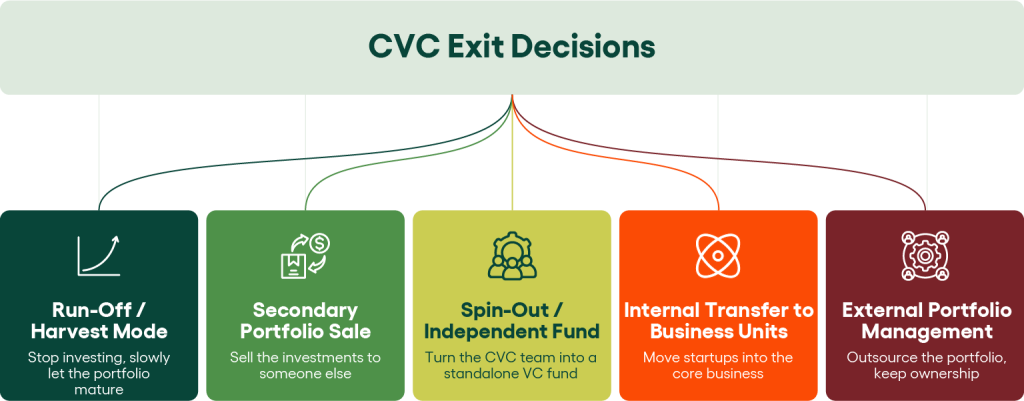
When a corporate parent elects to scale back or exit its venture program, the question is not simply how to dispose of assets, but how to do so in a way that preserves value, minimizes operational friction, and maintains the corporation’s standing in the startup ecosystem. Over the past decade, five primary pathways have emerged, each with distinct mechanics, incentives, and implications for the parent organization.
Run-Off or Harvest Mode:
The most straightforward option is a controlled run-off of the existing portfolio. In this model, the CVC unit stops making new investments and focuses entirely on managing existing positions until they reach liquidity events. The portfolio is actively monitored, governance responsibilities are maintained, and the corporation seeks to maximize outcomes through continued board participation, structured follow-on decisions, and strategic support where appropriate.
The advantages lie in stability and value capture. It avoids the valuation discounts associated with bulk secondary sales, maintains founder relationships, and gives the parent optionality should strategically relevant companies mature in desirable ways. However, the drawbacks can be significant. A run-off can take years, creating a long-tail burden on finance, legal, and innovation leadership. Talent retention becomes difficult in a group tasked with managing assets that are no longer core to the corporate strategy. Liquidity realization is typically slow and unpredictable.
Run-off is most often used in industries with long technology cycles, such as industrials, energy, and telecommunications, where assets may retain strategic relevance for longer periods even if the parent is no longer investing aggressively. In many cases, a run-off becomes the default choice when leadership decides against aggressive divestiture or lacks a catalyst for a cleaner transition.
Secondary Portfolio Sale:
A faster and increasingly common route is the sale of the portfolio, in whole or in part, to specialized secondary buyers. These buyers include private equity firms, dedicated secondary funds, and funds-of-funds seeking exposure to later-stage venture assets at negotiated discounts.
Pricing is typically based on a negotiated percentage of the most recent valuations, adjusted for growth prospects, governance rights, and company-specific risks. Structures range from outright sales of individual line items to full portfolio sales with deferred earn-outs or contingent payments tied to future exits.
The appeal is clear: immediate liquidity, removal of administrative overhead, and a clean reset of corporate exposure. But the challenges are equally material. The discounts can be substantial, particularly for early-stage or illiquid positions. There is also reputational risk: founders and co-investors may interpret a bulk sale as a signal of disengagement. Furthermore, the corporation forfeits any strategic rights, including information access or acquisition optionality. Notable examples include divestitures by Comcast, Dow, and several financial institutions that sought to streamline their balance sheets during strategic restructurings.
Spin-Out or Independent Fund Transition:
A more nuanced option is to convert the CVC team into an independent venture fund, with the corporation remaining involved as an anchor limited partner. This structure preserves continuity, protects relationships, and retains strategic access to emerging technologies while shifting operational responsibility off the corporate balance sheet.
The structural considerations are nontrivial: negotiating carry, management fees, governance rights, and any ongoing strategic collaboration frameworks requires alignment between the parent and the new general partner. But when executed well, the result can be a best-of-both-worlds scenario. BMW i Ventures, Gradient Ventures, and GE Ventures all transitioned portions of their programs into variants of this model, enabling corporate parents to maintain visibility into innovation trends without the burden of operating a venture unit directly.
Internal Transfer to Business Units or Corporate Development:
In cases where specific portfolio companies have clear operational relevance, assets can be transferred directly into business units or corporate development. This path is appealing when the corporate sees near-term potential for commercial integration, joint development, or acquisition.
Its strength is alignment: instead of sitting inside an innovation arm, the startup becomes directly linked to the business stakeholders most capable of deriving value from it. However, the risks are real. Operating units often lack venture experience, while hitting quarter goals are typically the focus of business units, leading to under-managed assets or strained founder relations. Value erosion can occur if the business unit deprioritizes the engagement or if integration expectations are misaligned. Industries like aerospace and energy have used this model selectively, typically for companies with strong product fit or clear strategic adjacency.
External Portfolio Management Partner or Managed Account:
Finally, an increasingly popular option has been to retain ownership of their venture stakes but outsource portfolio management to an external specialist. Certain firms have built specific expertise and infrastructure to manage corporate venture portfolios through structured mandates or managed accounts.
This option provides professional oversight and operational execution with minimal internal burden, maintains relationships with founders, and allows the parent company to exit gradually and cleanly. The trade-offs are reduced visibility into day-to-day portfolio offering, portfolio manager compensation, and a slower path to disengagement. The model is most effective when the corporation wants to preserve strategic exposure without dedicating internal resources to a long-tail portfolio. To ensure this is a viable option, CVCs should select partners with a proven track record of managing the transition of such assets, while having the legal, operational, and regulatory infrastructure to seamlessly manage the complexity.
Together, these five pathways form the core strategic toolkit for CVCs navigating an exit or repositioning. The right choice depends on corporate objectives: speed, liquidity, strategic continuity, reputational considerations, and internal bandwidth.
VI. Comparing the Exit Pathways: Strategic Objectives and Trade-Offs
Selecting the optimal path for exiting or transitioning a corporate venture capital program requires a careful assessment of both corporate priorities and portfolio characteristics. Each exit or transition strategy offers distinct advantages and trade-offs, which must be evaluated in the context of strategic alignment, financial objectives, operational capacity, and reputational considerations.
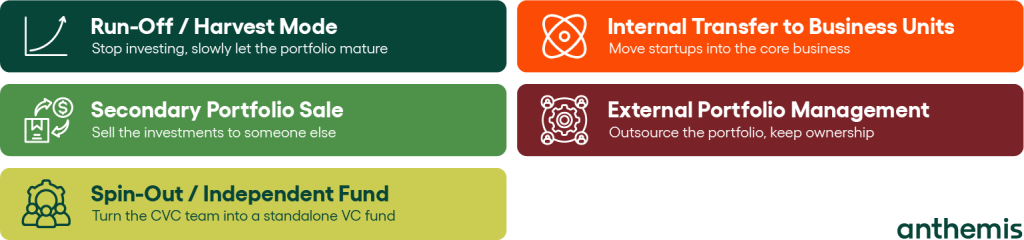
Run-Off or Harvest Mode – provides a controlled and deliberate approach. By managing existing positions to maturity, the corporation preserves maximum optionality, maintains relationships with founders and co-investors, and avoids the steep discounts often associated with bulk sales. The trade-offs include slower liquidity realization, extended operational burden, and the potential for talent attrition as the team shifts into a maintenance-focused role. This pathway is most appropriate for mature portfolios with strategic relevance or for corporates seeking to avoid abrupt disengagement from the innovation ecosystem.
Secondary Portfolio Sale – offers immediacy and clarity. By selling stakes to secondary buyers, corporations can rapidly recover capital and simplify balance sheet exposure. The principal advantages are liquidity and operational relief. However, this approach can involve significant valuation discounts, forfeiture of strategic rights, and potential reputational impact with founders or co-investors. Corporations often favor this approach when leadership prioritizes capital redeployment, risk reduction, or a rapid exit timeline.
Spin-Out or Independent Fund Transition – balances continuity with operational independence. Transforming the CVC team into a separate venture fund allows the parent to retain access to emerging technologies and insights while reducing internal management overhead. The structure requires careful alignment on economics, governance, and ongoing collaboration. Pros include the preservation of institutional knowledge, continued ecosystem credibility, and strategic optionality. The trade-offs involve negotiating complex agreements, potentially sharing upside with external investors, and relinquishing direct control over investment decisions.
Internal Transfer to Business Units or Corporate Development – aligns portfolio assets with operational priorities. By folding strategically relevant companies into business units, the corporation can accelerate integration, foster innovation synergies, and position for future acquisitions. Advantages include closer linkage to the core business and direct realization of strategic value. Risks involve mismanagement due to limited VC experience, dilution of focus within operating units, and potential erosion of portfolio value if integration is poorly executed. This pathway is most effective for companies whose technologies or products have immediate relevance to the parent’s operations.
External Management Portfolio Partner or Managed Account – retains ownership while outsourcing portfolio oversight. Partnering with specialized portfolio managers allows for professionalized oversight, structured governance, and reduced internal burden. The benefits include continuity of portfolio management and preservation of relationships with founders. Trade-offs include portfolio manager compensation, reduced visibility into day-to-day portfolio operations, and slower disengagement timelines. This approach works best when the corporate desires to maintain long-term exposure without committing internal resources to active management.
Increasingly, corporations are turning to specialized portfolio management products and services to support this transition. These platforms provide critical capabilities such as valuation tracking, governance workflows, deal documentation management, and visibility into syndicate dynamics that help a corporation prepare its portfolio for exit. Services such as managed accounts, outsourced portfolio oversight, and strategic advisory support enable CVCs with limited internal bandwidth to execute a structured, data-driven harvest process. By leveraging these tools, corporations can improve transparency, reduce operational risk, and accelerate exit readiness across the portfolio.
Ultimately, the choice of exit pathway depends on how the corporation prioritizes speed, liquidity, strategic continuity, control, and ecosystem reputation. A deliberate framework that maps these priorities against portfolio characteristics, investment stage, and organizational capacity enables leadership to make informed decisions. Corporations that approach this decision strategically—rather than reactively—maximize both financial and strategic outcomes while ensuring the CVC program concludes in a manner that reinforces the company’s credibility and innovation objectives.
VII. Managing the Transition Process
Exiting or restructuring a corporate venture capital program is a complex process that extends beyond portfolio disposition. Effective transition management ensures that value is preserved, relationships are maintained, and the corporation’s reputation within the innovation ecosystem remains intact. Successful transitions rely on careful planning across governance, valuation, communication, legal compliance, and talent management.
Governance is the foundation of a structured transition. Clear decision-making authority should be established early, defining who can approve portfolio sales, spin-outs, transfers, or managed accounts. This typically involves the CFO, corporate development team, business unit leaders, and, in some cases, the board of directors. Maintaining a formal governance framework ensures that exit decisions are aligned with corporate strategy and financial policies, while mitigating the risk of inconsistent or ad hoc actions.
Valuation and financial oversight are critical to ensure that the corporation realizes fair value. Independent third-party valuations, supported by clean data rooms and transparent financial reporting, provide confidence to internal stakeholders and reduce potential disputes during portfolio sales or spin-outs. For secondary sales or partial dispositions, clear methodologies for pricing, earn-outs, and contingent considerations should be defined to balance liquidity needs against maximizing return.
Communication and stakeholder management are essential to preserve relationships with founders, co-investors, and internal stakeholders. Corporations must carefully articulate the rationale for the transition, maintain transparency about timelines and expectations, and provide assurances regarding ongoing support or engagement where appropriate. Poor communication can damage long-term credibility and limit access to future investment opportunities or strategic partnerships.
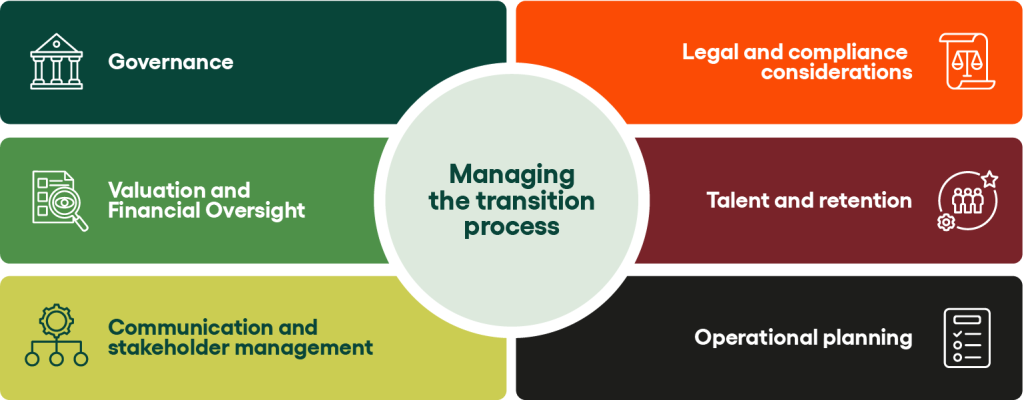
Legal and compliance considerations play a pivotal role in structuring exits and will differ significantly based on the approach taken to the transition. Early involvement of legal and compliance teams to scope out the documentation and approvals required for the transition and agree terms with all stakeholders is essential for smooth portfolio disposition, particularly for cross-border holdings or regulated industries.
Talent and retention are often underestimated but crucial for maintaining continuity and executing an orderly exit. CVC teams may be asked to oversee run-offs, support spin-outs, or coordinate portfolio transitions. Offering clear career paths, retention incentives, or opportunities within spin-outs helps prevent attrition and ensures that institutional knowledge is preserved. A well-managed talent strategy mitigates operational risk and sustains morale during periods of uncertainty.
Operational planning should include detailed timelines, milestone tracking, and contingency scenarios. Whether the exit involves a run-off, secondary sale, spin-out, internal transfer, or managed account, establishing a step-by-step plan ensures that processes are repeatable, resources are allocated effectively, and risk is minimized. Metrics for monitoring progress—such as liquidity realized, portfolio coverage, and stakeholder satisfaction—allow leadership to adjust course as needed.
In summary, managing a CVC transition is as much about process as it is about strategic choice. Corporations that prioritize structured governance, disciplined valuation, transparent communication, legal process management, and talent management are better positioned to execute exits that preserve value, maintain credibility, and maximize strategic optionality. By approaching the transition systematically, a CVC can conclude not as a legacy liability but as a demonstrable success in innovation management.
Conclusion
The pathways outlined in this paper: run-off, secondary sale, spin-out, internal transfer, and external management offer a spectrum of options tailored to different corporate objectives. Each requires careful consideration of trade-offs between liquidity, strategic continuity, control, and reputation. What separates successful transitions from mismanaged ones is deliberate planning, disciplined execution, and a commitment to preserving relationships with founders, co-investors, and internal stakeholders.
The call to action for corporate investors is clear: treat portfolio harvesting and exit strategy with the same rigor as the investment process. Establish governance frameworks, assess financial and strategic priorities, communicate transparently, and plan early. By doing so, corporations can convert the back end of their venture lifecycle into a source of tangible financial return, operational insight, and enduring innovation advantage. In short, a well-managed exit can ensure that the CVC leave a legacy of value, credibility, and strategic optionality, positioning the company to engage confidently with the next wave of disruptive opportunity.
To explore strategic harvesting options for your CVC, contact ecosystem@anthemis.com